
Description
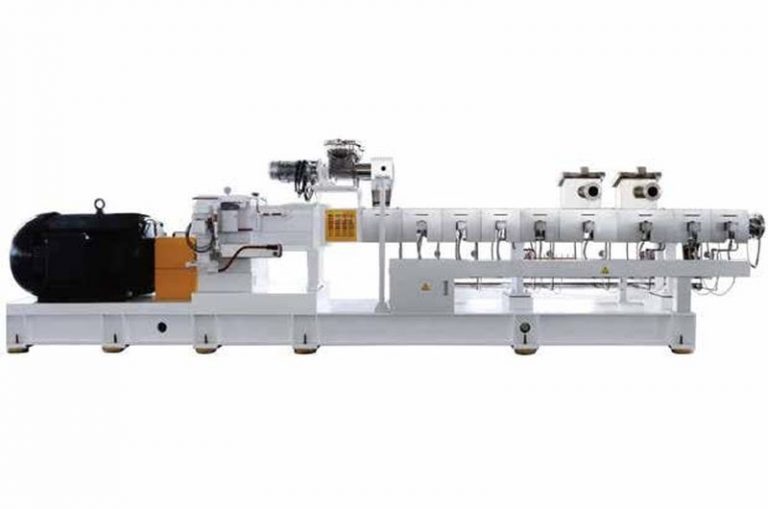
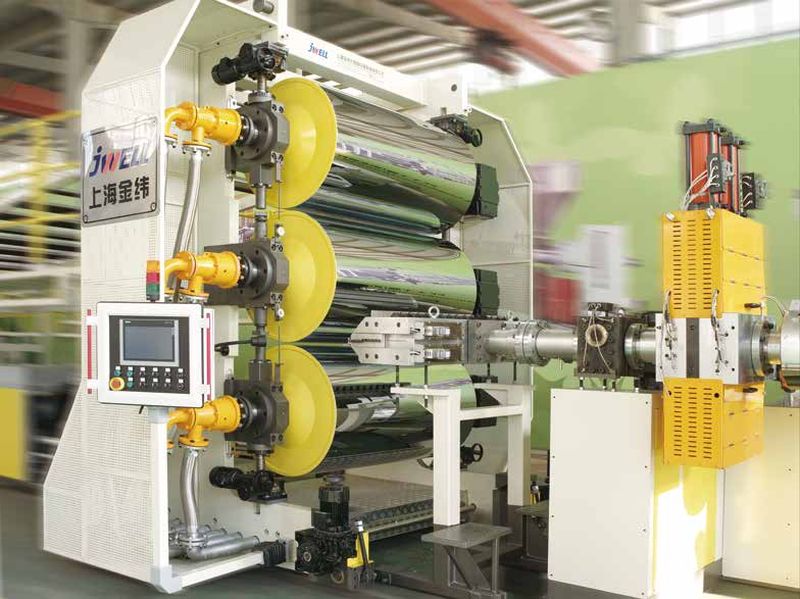
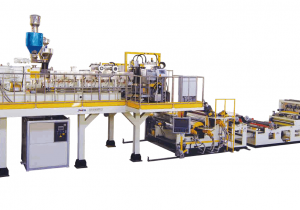
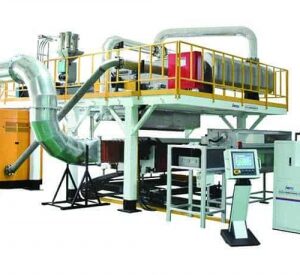
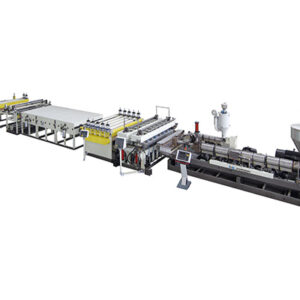
JWELL company has innovated and developed a PP (polypropylene) high-filled floor production line. Its products can replace PVC (polyvinyl chloride) floor to achieve health, and environmental protection, non-toxic and harmless. It can be widely used in homes, offices, shopping malls, hospitals, and other civil and commercial places.
Production line Specification
| Thickness range | 2-6mm |
| Width range | 1000-2000mm |
| Capacity range | 1000-2500KG/h |
Typical PVC Free Flooring Extrusion Process
Raw Material Feeding → Extrusion & Melting → Additive Mixing → Sheet/Layer Forming → Calendering or Die Shaping → Embossing → Cooling → Surface Treatment → Cutting → Winding or Stacking
Key stages include:
- Raw Material Feeding
Polymer resins, mineral fillers, pigments, stabilizers, and other formulation components are accurately fed into the extrusion system.
- Extrusion and Melting
The extruder melts and homogenizes the material under controlled temperature and shear conditions. Twin-screw extrusion may be used when intensive mixing or compounding is required.
- Layer Formation
Depending on the flooring structure, one or multiple extruders can feed different material layers, such as a backing layer, decorative layer, and wear-resistant surface layer.
- Sheet Forming and Calendering
The molten material is shaped into a continuous flooring sheet through a flat die, calender rolls, or another forming system. Thickness and dimensional uniformity are carefully controlled.
- Embossing and Surface Finishing
Embossing rolls can create wood, stone, textile, or other surface textures. Additional coating or treatment equipment can be integrated for specific surface requirements.
- Cooling and Stabilization
Controlled cooling reduces thermal deformation and helps maintain the required sheet thickness, flatness, and dimensional stability.
- Cutting and Winding/Stacking
Flexible flooring can be wound into rolls, while rigid or semi-rigid flooring products can be cut into sheets, planks, or tiles and then stacked for packaging.
PVC Free Flooring Extrusion Line Applications
PVC-free flooring extrusion lines are mainly used for producing commercial, residential, industrial, and specialized resilient flooring where manufacturers want to avoid PVC-based formulations.
- Residential Flooring
PVC-free extrusion technology can produce flooring for houses, apartments, and other residential interiors. Depending on the formulation, products can be designed with decorative wood, stone, or contemporary patterns.
Typical applications include:
- Living rooms
- Bedrooms
- Kitchens
- Hallways
- Home offices
- Residential renovation projects
- Commercial Flooring
PVC-free flooring is also applicable to commercial interiors where attractive appearance, wear resistance, and easy maintenance are important.
Typical end uses include:
- Offices
- Retail stores
- Shopping centers
- Hotels
- Restaurants
- Public buildings
- Healthcare and Institutional Flooring
Specialized PVC-free formulations can be processed into flooring designed for hospitals, clinics, schools, laboratories, and other institutional environments. The final specification should be matched to the required hygiene, cleaning, slip-resistance, and fire-performance standards.
- Educational and Public Facilities
Extruded PVC-free flooring can be manufactured for:
- Schools and universities
- Libraries
- Community facilities
- Public transportation interiors
- Exhibition and multipurpose spaces
Manufacturers can adjust the flooring structure and surface design according to the intended environment.
- Eco-Conscious Building Projects
One important application is flooring development for projects seeking to reduce or eliminate PVC from their material portfolio. PVC-free extrusion enables manufacturers to develop alternative flooring constructions based on PP, PE, TPO, TPU, PET, or other suitable polymers.
This can be particularly relevant for projects with specific material-selection, sustainability, recycling, or indoor-environment requirements.
- Decorative Flooring
The extrusion line can be configured for multilayer flooring with printed or decorative surfaces. This allows manufacturers to reproduce the visual appearance of:
- Natural wood
- Marble and stone
- Concrete
- Ceramic
- Textile
- Custom graphic patterns
- Specialized Industrial Flooring
With appropriate material formulations and line configurations, PVC-free flooring can also be developed for selected industrial and technical applications where resistance to chemicals, abrasion, moisture, or mechanical loads is required.
Why Choose a PVC Free Flooring Extrusion Line?
The main advantage is material flexibility. Rather than being restricted to PVC-based formulations, manufacturers can develop flooring systems using different polymer families and adapt the formulation for specific applications.
Other important considerations include:
- PVC-free material options for specific product strategies
- Multilayer extrusion capability for functional flooring structures
- Consistent thickness and surface quality
- Flexible decorative design options
- Continuous high-volume production
- Integration with embossing, cooling, cutting, and winding systems
- Formulation flexibility for different performance requirements
Final insight
A PVC free flooring extrusion line is not just a conventional sheet extrusion system; it is a configurable manufacturing platform for producing flooring based on alternative polymer formulations. Its applications range from residential and commercial flooring to healthcare, institutional, decorative and specialised flooring. The final line configuration is determined by the polymer system, flooring structure, thickness, surface design and required performance.
Reviews
There are no reviews yet.