

Description
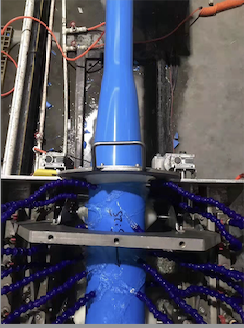
PVC-O pipe is the latest evolved form of PVC pipe. It is a type of pipe manufactured through a special orientation processing technology (biaxial stretching technology). The PVC-U (M) pipes produced by the extrusion method are axially and radially stretched, enabling the long-chain PVC molecules in the pipes to be regularly arranged in a biaxial direction, resulting in a new type of PVC pipe with high strength, high toughness, high impact resistance, and crack resistance.

Application fields:
PVC-O is mainly applied in fields such as water supply pipelines, mine pipelines, pipelines for trenchless laying and repair, gas pipeline networks, and power and communication protection pipelines.


Comparison of conventional materials:
| Serial number | Performance | PVC-U | PE | PVC-O |
| 1 | Mechanical properties – Impact resistance | It is brittle below 5℃, and its compressive performance is average. | Slow cracks appear, and the compressive performance is average. | Resistant to low temperatures, with better impact resistance at room temperature; effectively prevents cracking. |
| 2 | Mechanical properties – Flexural resistance | It is not easy to bend, has poor toughness; construction is inconvenient and special fittings are required for connection. | It is relatively easy to bend, but requires a greater wall thickness under the same pressure. | It is more flexible and has better toughness. Under the same pressure, the wall thickness is relatively thin, which is convenient for construction. When the bending is ≤15°, no special fittings are required for connection. |
| 3 | Environmental performance – carbon emissions | Use less non-renewable petroleum raw materials, but use more raw materials, resulting in a higher carbon emissions. | Using more non-renewable petroleum raw materials and a larger amount of raw materials will result in higher carbon emissions. | Use less non-renewable petroleum raw materials and fewer raw materials, resulting in the lowest carbon emissions. |
Cost analysis:
Compared with PE pipes, Ф315 PVC-O and PVC-U pipes have the following characteristics: the wall thickness of PVC-O pipes is 6.2 mm, the wall thickness of PVC-U pipes is 12.1 mm, and the wall thickness of PE pipes is 18.7 mm. The weight of PE pipes per meter is about 1 kg heavier than that of PVC-U pipes and 9 kg heavier than that of PVC-O pipes. This means that when using PVC-O pipes with the same diameter and pressure, users can save 9 kg of raw material cost per meter. Therefore, when laying a one-kilometer-long pipeline, users can save 9 tons of raw material cost. In addition, the price of PE raw materials is about 3,500 yuan higher per ton than that of PVC raw materials. Therefore, users can save a significant amount of material costs by choosing PVC-O pipes.
| Types of pipes | Specifications | Pressure level | Wall thickness of pipes | Unit weight (kg/m) |
| PVC-O | φ315 | 1.0MPa | 6.2mm | 9.36 |
| PVC-U | φ315 | 1.0MPa | 12.1mm | 17.856 |
| PE100 pipe | φ315 | 1.0MPa | 18.7mm | 18.339 |
Water flow analysis:
The wall of the PVC-O pipeline is thin, and the water passage area is large. If the flow velocities of these two types of pipelines are both set at 1 m/s, when comparing a 315mm×1.0MPa PVC-O pipeline with a PE pipeline, the flow rate of the PVC-O pipeline is 258.9 m³/h and 6213.6 m³/d, while the flow rate of the PE pipeline is 217.9 m³/h and 5229.3 m³/d. From the comparison of the above set of figures, it can be seen that compared with the flow rate of the PE pipeline, the PVC-O pipeline can transport approximately 984 m³ more water per day, and nearly 360,000 m³ more water for users in a year. Undoubtedly, this saves a large amount of electricity costs.


Reviews
There are no reviews yet.